Every day, millions of people consume educational content through online courses, podcasts, audiobooks, and video essays. But many of us have experienced the exact same frustration: finishing an hour-long lecture only to realize we remember surprisingly little of what was just said.
This is not necessarily because we were not paying attention. It is because our brains encode and store information best when we are actively engaged with it, rather than simply letting it wash over us.
What Is Immersive Reading?
Immersive reading is a strategy that combines multiple senses during learning - typically listening to spoken words while simultaneously following the written text. Instead of relying on audio or text alone, learners process the exact same information through both visual and auditory channels at once.
This approach is heavily supported by Richard Mayer's Cognitive Theory of Multimedia Learning, specifically the “Dual-Channel Hypothesis.” The human brain processes visual information and auditory information through two separate channels. When you only listen to a video, your auditory channel can become easily overwhelmed, leading to cognitive overload. By reading the text as it is spoken, you distribute the cognitive load across both channels, significantly improving comprehension.
Common examples of this include:
- Listening to an audiobook while reading the physical ebook.
- Following highlighted text as a narrator speaks.
- Reading accurate subtitles while watching educational videos.
Why Many People Naturally Follow Along
For decades, educators have encouraged beginning readers to follow text with their fingers to build reading fluency. However, adults naturally use similar strategies to combat modern screen fatigue.
Have you ever found yourself highlighting text as you read a dense PDF, following a cursor along the lines of an article, or using line-focus reading tools? These techniques create a visual anchor. A visual anchor reduces attentional drift - the phenomenon where your eyes continue to move down a page while your mind wanders to a completely different subject. By guiding your eyes with a moving point, you drastically reduce the need for rereading and maintain sustained focus during long study sessions.
Building on Immersive Reading
At TrainRun, we looked at the science of multimodal learning and asked a simple question: what if following the words was not just easier, but inherently engaging?
Instead of asking users to manually track text with a cursor or finger, the TrainRun engine transforms standard educational video transcripts into the path of an auto-runner game.
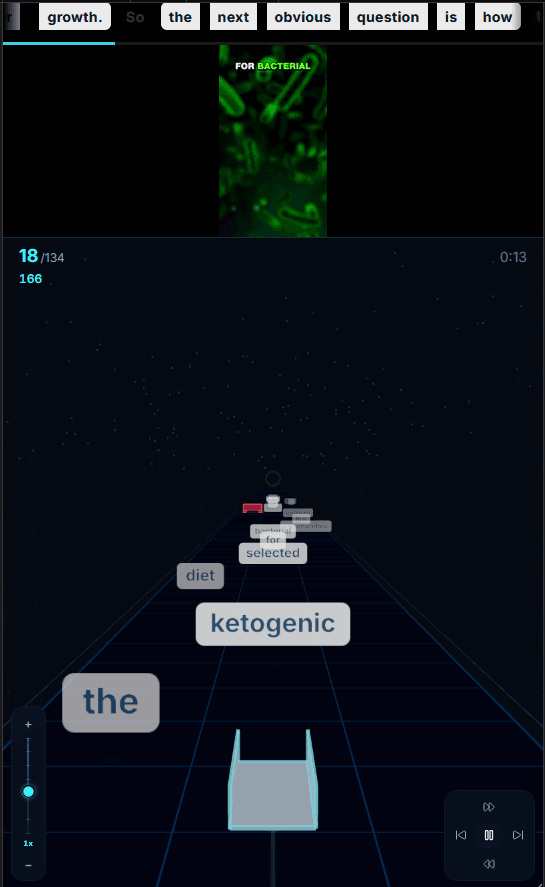
As the video plays, the mechanics of the game keep the learner anchored:
- Each collected word reinforces immediate attention to the spoken phrase.
- The player's eyes stay locked on a single, continuously moving point.
- Physical engagement (moving the train) becomes seamlessly integrated with the learning experience.
The goal is not to replace reading entirely. The goal is to provide a mechanical tool that encourages continuous, unbroken attention while consuming long-form educational media. The underlying technique builds on the same principles as active recall - forcing engagement with concepts at the moment they appear, rather than letting them pass by unprocessed.
Learning Does Not Stop When the Video Ends
If you want to remember something next week, simply paying attention today is not enough. In the late 19th century, psychologist Hermann Ebbinghaus discovered the forgetting curve, demonstrating that humans lose a massive percentage of newly learned information within hours unless they actively attempt to recall it.
Educational psychology consistently shows that one of the strongest ways to halt the forgetting curve is retrieval practice - attempting to recall information from memory rather than simply rereading your notes.
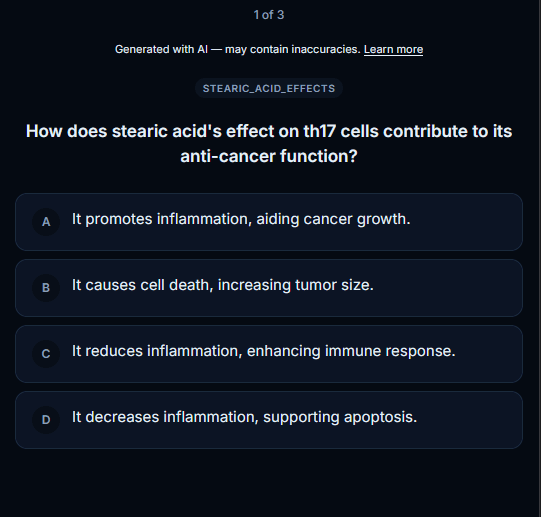
That is exactly why the TrainRun engine automatically generates interactive quizzes immediately after each learning section. Instead of allowing users to passively auto-play the next chapter, the application pauses to encourage retrieval while the ideas are still fresh. Research on the testing effect consistently finds that actively recalling information strengthens neural pathways and solidifies long-term memory far more effectively than passive review alone.
Who Can Benefit?
Different learners prefer different methods, but active multimodal learning is especially useful for people who:
- Frequently lose focus or experience attentional drift while reading on screens.
- Regularly forget the core concepts of videos they just watched.
- Enjoy learning through interactive, gamified experiences.
- Currently use audiobooks alongside physical ebooks to stay engaged.
- Face long, dense study sessions that require sustained, heavy attention.
Looking Ahead
Today, TrainRun focuses on bridging the gap between passive educational videos and active learning. In the future, we plan to expand these mechanics to additional forms of long-form learning, including dense technical articles and audiobooks.
Our vision is not simply to gamify learning for the sake of entertainment. It is to explore how active engagement, multimodal reading, and structured retrieval practice can help everyone retain more of the knowledge they choose to pursue. For a deeper look at the learning science that underpins this approach, see our articles on learning from video and spaced repetition.